
April 2, 2022 marks the 20th anniversary of our beloved coffee shop, Coco’s Coffee and Fine Chocolates, in West Akron (later rebranded Nervous Dog Coffee).
Fun fact: As a nod to its history by current owner Michael Litt, the Nervous Dog brand character is named “Coco.” I remain a proud Godmother of the expanded chain.
Starting a business from scratch is a lot like giving birth; its like a child – expensive and time consuming at first, then a source of joy and pride (if well behaved) as it matures. And in many cases, the staff becomes part of that child’s family. Even when adopted (i.e., sold), that startup stays on your mind and in your heart.
When my partner at the time and I first talked about expanding our already successful stationery shop to include fine chocolates, we had no idea at the time that the idea would expand into a small chain of coffee shops. Between our brides who needed wedding favors and chocolates being a top gift category, it made sense to grow into a new category. But at that time, our retail storefront would have to be food service licensed to sell truffles from a display case. Unable to expand our existing space to accommodate the food-safety requirements, we rented space a block away. Coffee was added to our original fine chocolate concept for day-to-day cashflow consistency.
Soon after, Coco’s Coffee and Fine Chocolates was born.
Coco’s was unique. The closest thing to my initial vision was the backroom of the former location of Vosges Haut-Chocolat on the Upper East Side in NYC. We started Coco’s before there was an Ethel’s Chocolate Bar/Lounge… before Starbucks expanded into our local mall… and before we fully understood the complexity of business growth and how to properly plan and manage for it.
Building out that first location came in right on budget. A risk, but we figured it was about the same price as one year of an MBA program at a top school. And better than an MBA, the lessons learned continue to benefit me and my clients – especially when it comes to building out a solid foundation for long-term growth. More on that in future articles.
20 years later, allow me to share a few of the lessons learned from that experience.
Three things we did right (i.e., advice for entrepreneurs)
1) Invest in the right coach. Money invested in consulting and business coaching helps you move forward faster and run smarter. It also reduces the potential for opportunity costs due to delays and missteps. To help us master the art of espresso and an espresso-based business, we hired the legendary Alex Finsenko. Alex introduced retail Italian espresso to the United States in the late 1960s in Berkley, Calif. In 1982, entrepreneur Dave Olsen spent a week with him so he could learn and incorporate Alex’s systems and know-how into his own retail coffee startup in Seattle. Dave and his business partner, Howard Schultz, soon named their baby “Starbucks.”
From the shop design to pulling the perfect shot, Alex helped fast-track our success. His fee, flight and per diem was worth every penny. Our numbers showed we had about 12 weeks to transform an office space into an approved food service space and start bringing in revenue immediately – no easy feat. But with the right coach and a great group of contractors, we made it happen. On April 2, 2002, we opened our doors. (A grateful shout out to our first customer, Heather Heslop Licata. She ordered a medium caramel latte.)
2) Partner with those who may eventually judge your fate. Delayed approvals in most any business can be expensive. Rejected proposals are even worse. One of the most valuable lessons learned is the importance of building positive relationships with those who must eventually approve what you do and how you do it. Knowing this, we worked closely with the City of Akron officials as well as our wonderful landlord and CPA, Stanley Apple, involving them in our plans from the start. Because of the that early collaboration, were able to keep things moving forward on approvals with no surprises. Decades later, when I tell my retail tire store owners to “make friends with OSHA,” they often raise an eyebrow in disbelief. Instead of begrudging them or their process, I’ve found that it’s far better (and more cost effective) to partner with those who will eventually hold you accountable. They might even help you exceed expectations, which can be a positive differentiator for you.
3) Share your why. Simon Sinek says to start with Why. Business operating system coaches tell you to know your Why. I believe you need to share your Why. My Why’s were both public and private, yet I shared them both.
Back in 2001 when we were talking about expanding, I came across the original 1920s mahogany bar (and backbar) that was salvaged from our favorite watering hole, Wanamaker’s Tavern. It was beautiful – a solid 26-foot mahogany plank top and art deco backbar. I wanted to preserve it as an installation, a testament to the beloved bar where my then-partner and I first met. So the idea of buying the woodwork to preserve a piece of local history, incorporating it into our shop design, was part of our Public Why.
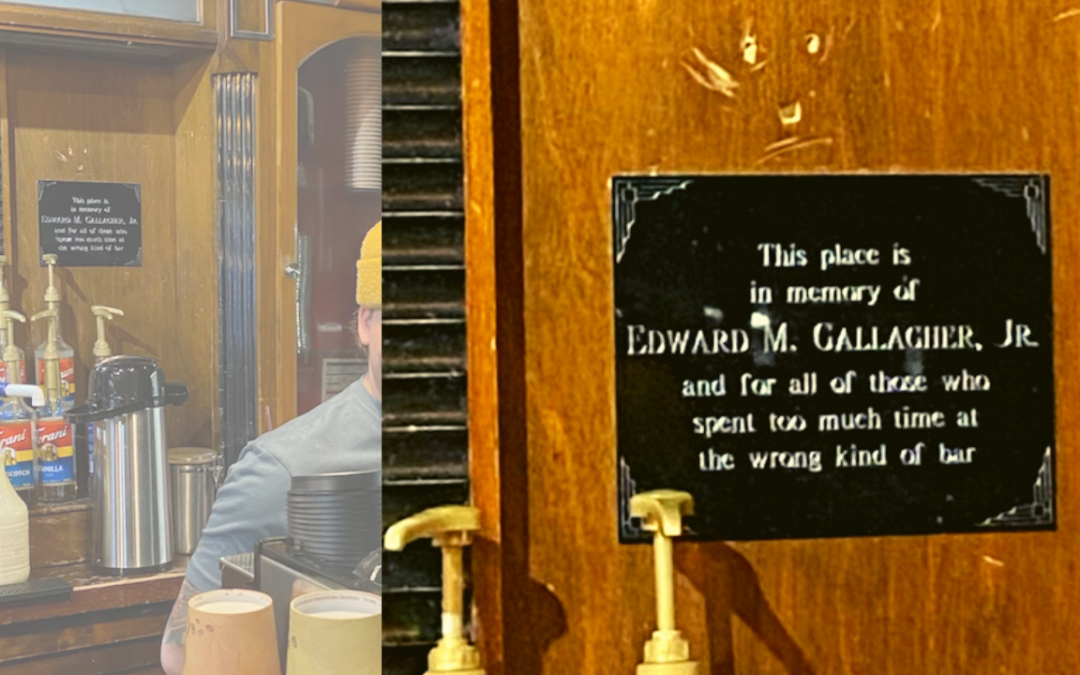
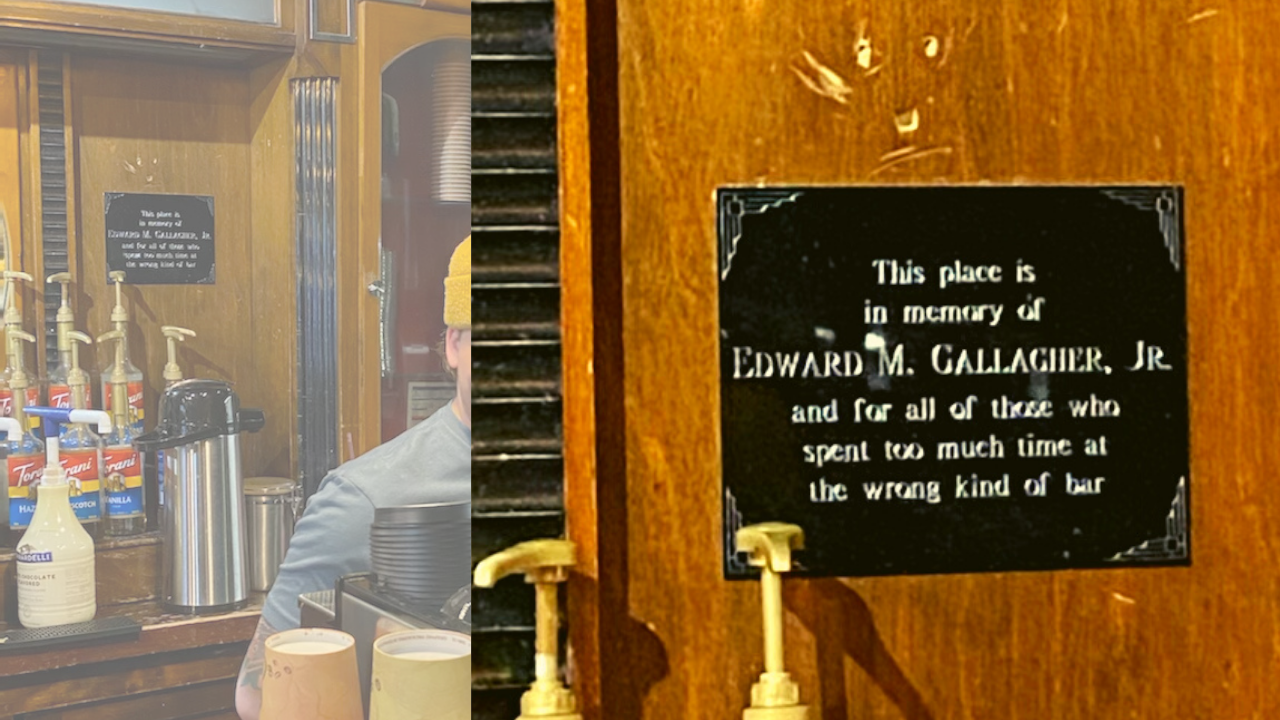
On a more personal level, I also wanted to preserve the memory of my uncle, Ed Gallagher. After high school at St. Vincent (also LeBron’s alma mater), he went straight to Korea and worked in a MASH unit. Years of witnessing the bloody conflict first-hand, once home his bright light became trapped inside a bottle. His drinking to numb his memories eventually killed him after decades of alcohol use syndrome. He was such a kind person. With no kids of his own, I wanted to be sure he was remembered. I often wonder what his life would have been like had he made different choices, so the coffee shop was dedicated to his memory and to others like him. People probably wonder about the sign on the bar behind the espresso machine. My Private Why was to make sure he doesn’t die twice, as the artist Bansky is quoted. Glad it still hangs there.
Three things we did wrong (i.e., lessons learned)
1) Embrace the competition: Leverage them and learn from them. Because we were somewhat early on the scene (aside from the iconic Angel Falls Coffee Co. in Highland Square), as an owner I was rattled every time a new shop would open. I thought they would put us out of business. The Grand Opening banners would pique my anxiety – which was already high as I was running two businesses across three locations, managing three staffs. If I had a grip on my business – if I had a strong method (operating system) and mindset – I would’ve realized that those other shops were a blessing. They raised awareness of the product. Their level of service gave a baseline against which we could continuously improve our own operation. Things they did well could provide inspiration for us to get better; things they did poorly could be used in our positioning as better.
Lesson: Instead of wringing your hands, look for the gift in your competition, finding ways to use the things they do – good and bad – to your advantage. Allow it to help accentuate what you are known for.
2) Create a Survival Guide and use it. Any business coach will tell you that the way you want things to be done, your business operational activities, need to be captured, documented and followed by all, almost every time. That standardized business process documentation – be it a binder, an employee manual or captured in a software system – should be seen as less of a chore and more of a “business survival guide.” While we thought we had processes and we did lots of training and quality checks, we didn’t have a complete outline of our expectations for the customer experience. We didn’t have a framework to support our shop culture. We didn’t attach expectations and measurables to each person’s role either. Aside from an opening and closing checklist, it was up to us as owners to be on top of things and to communicate constantly. It was exhausting.
Lesson: Create clear agreements on expectations with staff so you can get out of the weeds of “in” to work “on.” Document these in clearly defined and repeatable processes followed by all with no exception. This would’ve made a huge difference in both our success and sanity. It’s one of the four pillars I now share with clients, and I believe it’s nearly impossible to successfully scale a business without them.
3) Be the best at your craft to serve the kind of customer you want most. Because we had been trained by the Godfather of Espresso himself, we were known to pull an amazing shot of real European-style espresso. Because of that, we had built a nice reputation with foodies across Northeast Ohio, especially those here from Italy and France. I loved the compliments, that it was the best espresso they’ve had since their last trip home. We were absolutely the best at our craft. But it wasn’t enough for us.
We didn’t want to miss out on sales from other market segments – we wanted all the business from everyone –so we gradually minimized the emphasis on the art of espresso to add more items to offer to more people. Smoothies… frozen lattes… Italian sodas… bubble tea (before it was a thing)… you name it. Even live music on weekends. We focused on kids, moms, students, young couples, old couples, rose growers (free coffee grounds), brides… on everyone… and on no one. As a result, our we struggled a bit more than we should have.
Lesson: When you try to be all things to all people, you limit your business’ ability to become indispensable and beloved by your ideal customer. It’s much harder to build a core following with a broad approach, and being known for your craft and really focusing in on that One Thing can help to insulate you from your competition. In our case, we needed our Blue Ocean – and we had a few drop of it with our foodie following – but didn’t take advantage at the time. Again, lesson learned.
In closing… Decades later, I remain a coffee snob. More than that, I remain committed to the success of the independent business owner. If you got any value from my lessons from this 20th anniversary tribute, I invite you to celebrate with me. Buy a cup of coffee at your locally owned coffeehouse this weekend and let’s raise a glass (or travel cup) to all small business owners, to the entrepreneurial spirit, and to your success.
Follow me at @marketinggrowthgroup or head over our website to subscribe to future articles. More to come. Cheers!